
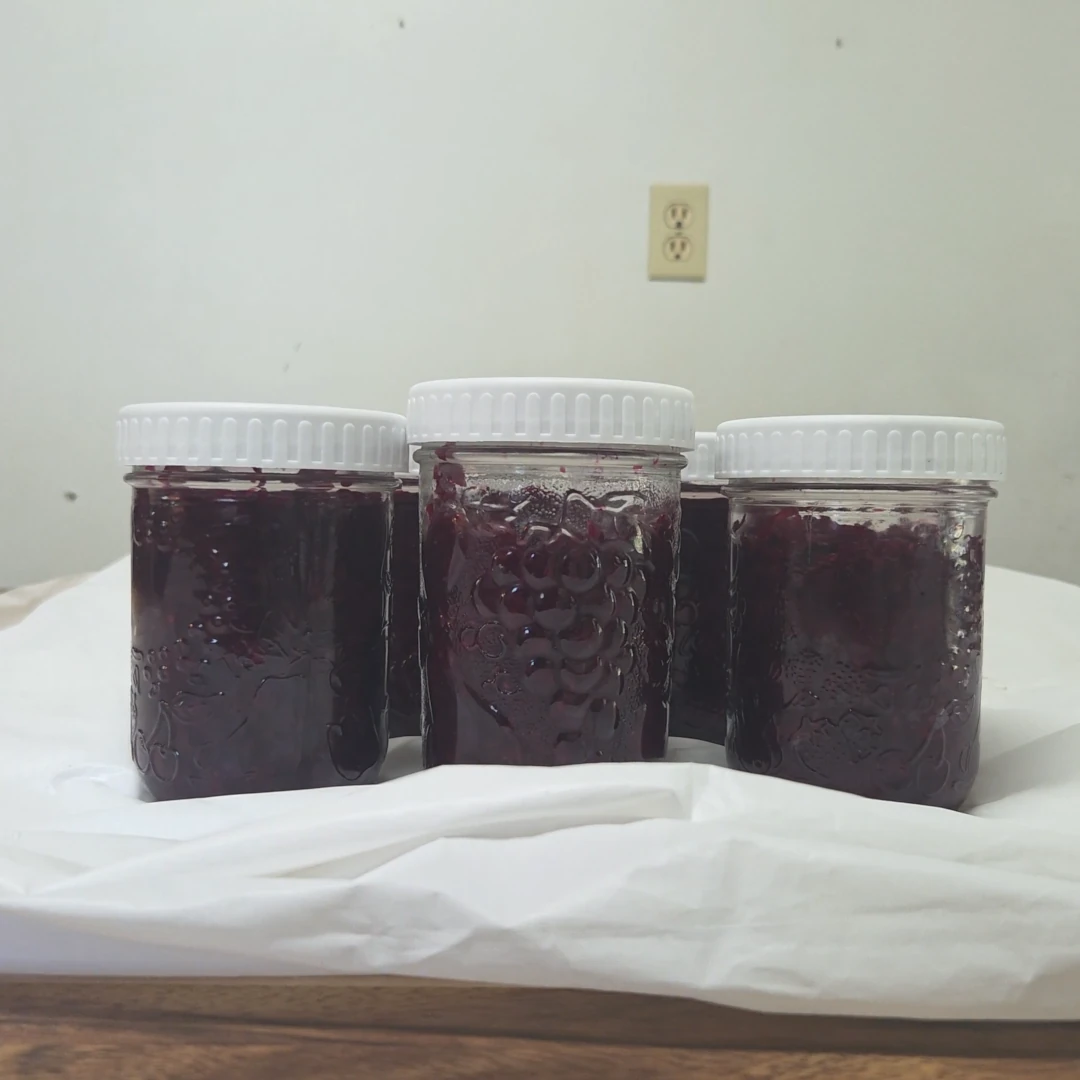
I bought a purple cabbage to make some red sauerkraut. I have made sauerkraut before, but this time I wanted to try it with red cabbage and see how it turned out.
I started by rinsing the cabbage and removing the core. Before doing anything else, I weighed the cabbage. It came in at 1500 grams.
I decided to use 2.5% salt, which meant I needed 37.5 grams of salt.
1500 grams × 0.025 = 37.5 grams of salt
I then removed the outer leaves and set them aside. I kept those leaves because I would use them later to cover the sauerkraut. The leaves need to be included in the total weight when calculating how much salt to use because they will eventually be under the brine along with the rest of the cabbage.
Next, I cut the cabbage into pieces small enough to fit into my food processor. I put the slicing blade in and ran the cabbage through until it was all sliced.
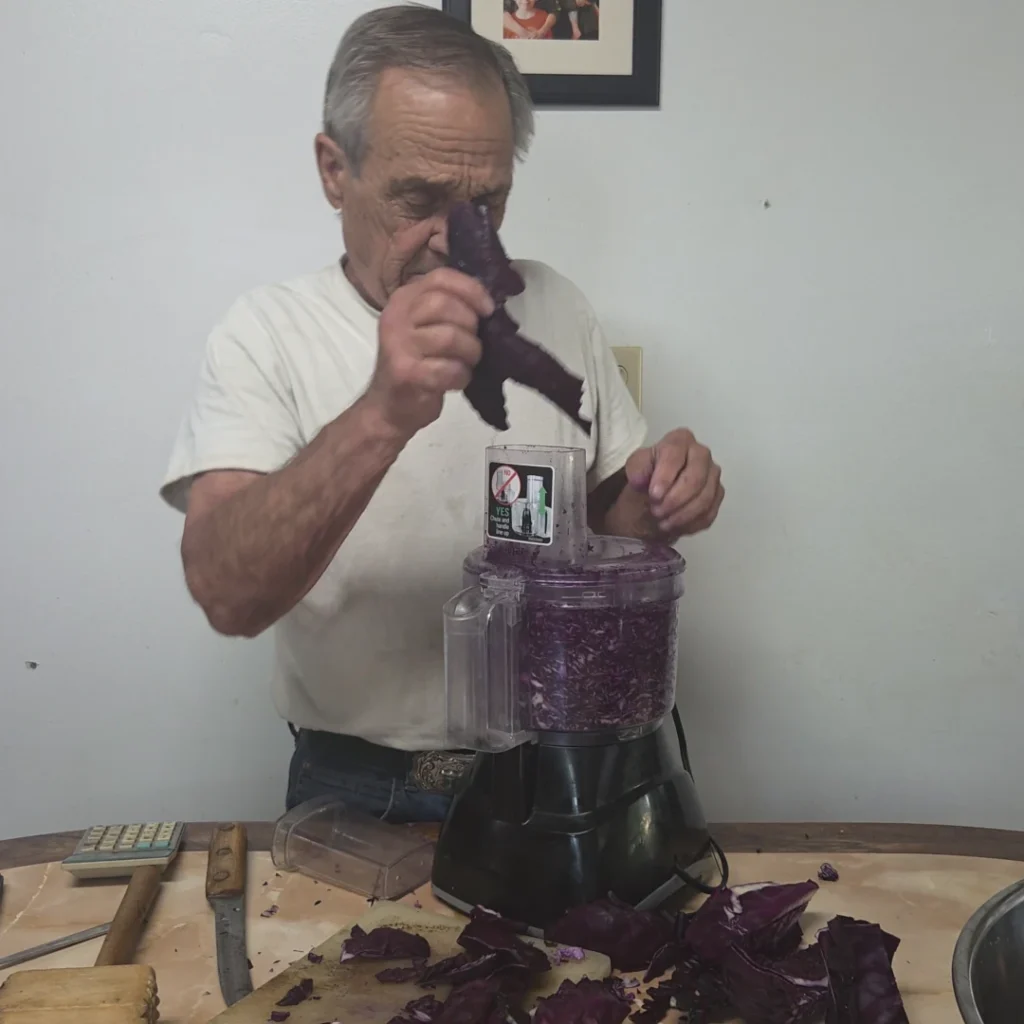
I put some of the sliced cabbage into a large bowl, sprinkled some of the salt over it, added more cabbage, and then added the rest of the salt. I mixed everything together and let it sit for about half an hour. This gave the salt time to start working its way into the cabbage and get the cabbage releasing some of its juice.
After it had sat for half an hour, I started crushing the cabbage to get as much juice out of it as I could. I spent about 20 minutes working the cabbage with my hands, squeezing and crushing it to release the juice.
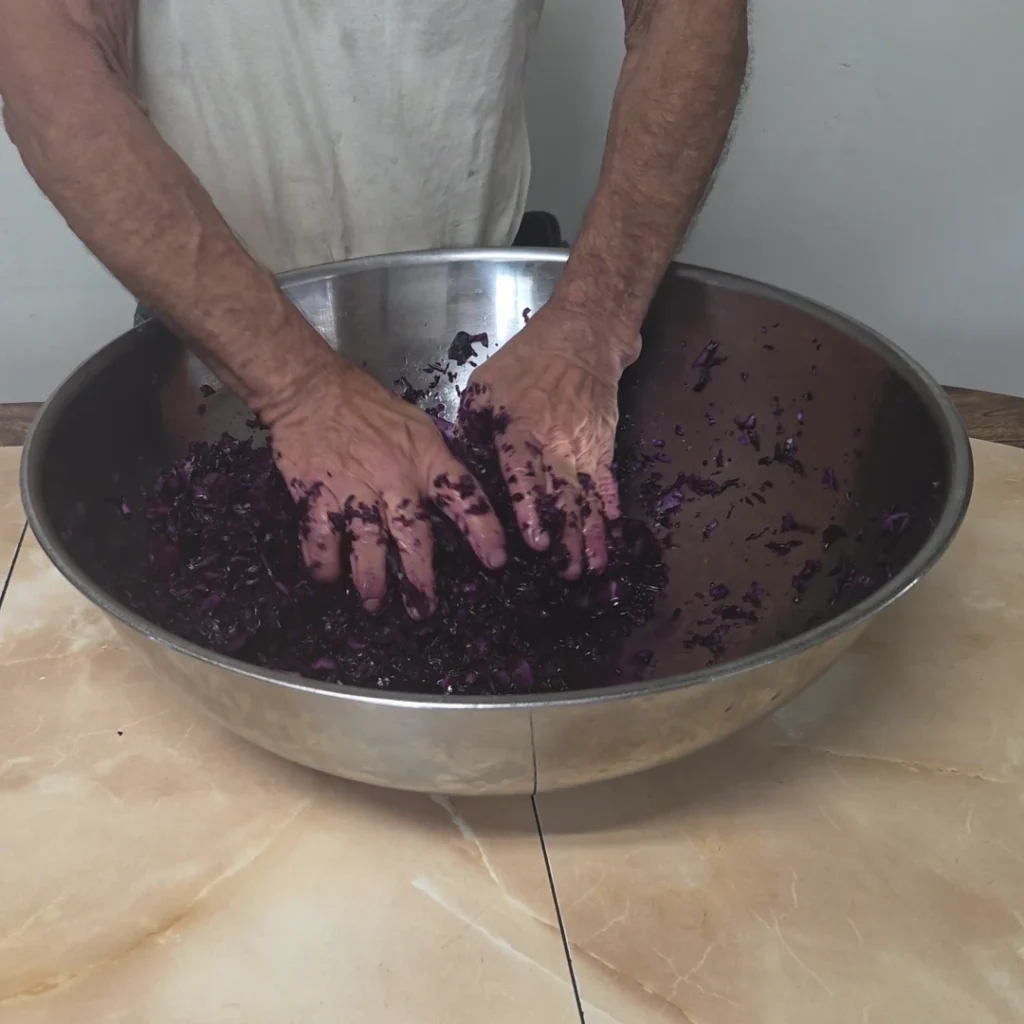
You want to get as much liquid out of the cabbage as you can because you need enough brine to completely cover the cabbage once it is packed into the container.
If your hands get tired, take a break. There is no rush. Let the cabbage sit for a while and then go back to it and work it some more. The more juice you can get out of the cabbage, the easier it is going to be to keep everything covered with brine.
Once I was satisfied with the amount of juice I had released, I put the cabbage and all of the juice into a one-gallon ice cream pail. I took the outer cabbage leaves I had saved earlier and laid them over the top of the sliced cabbage.
I pressed everything down as well as I could, but at that point the brine didn’t quite cover the cabbage.
To keep the cabbage submerged, I put a freezer bag over the top and filled the bag with a 2.5% salt-water brine. The bag acts as a weight and presses down on the cabbage, while the brine in the bag is there in case the bag leaks. I covered the pail with a towel and left it to ferment.
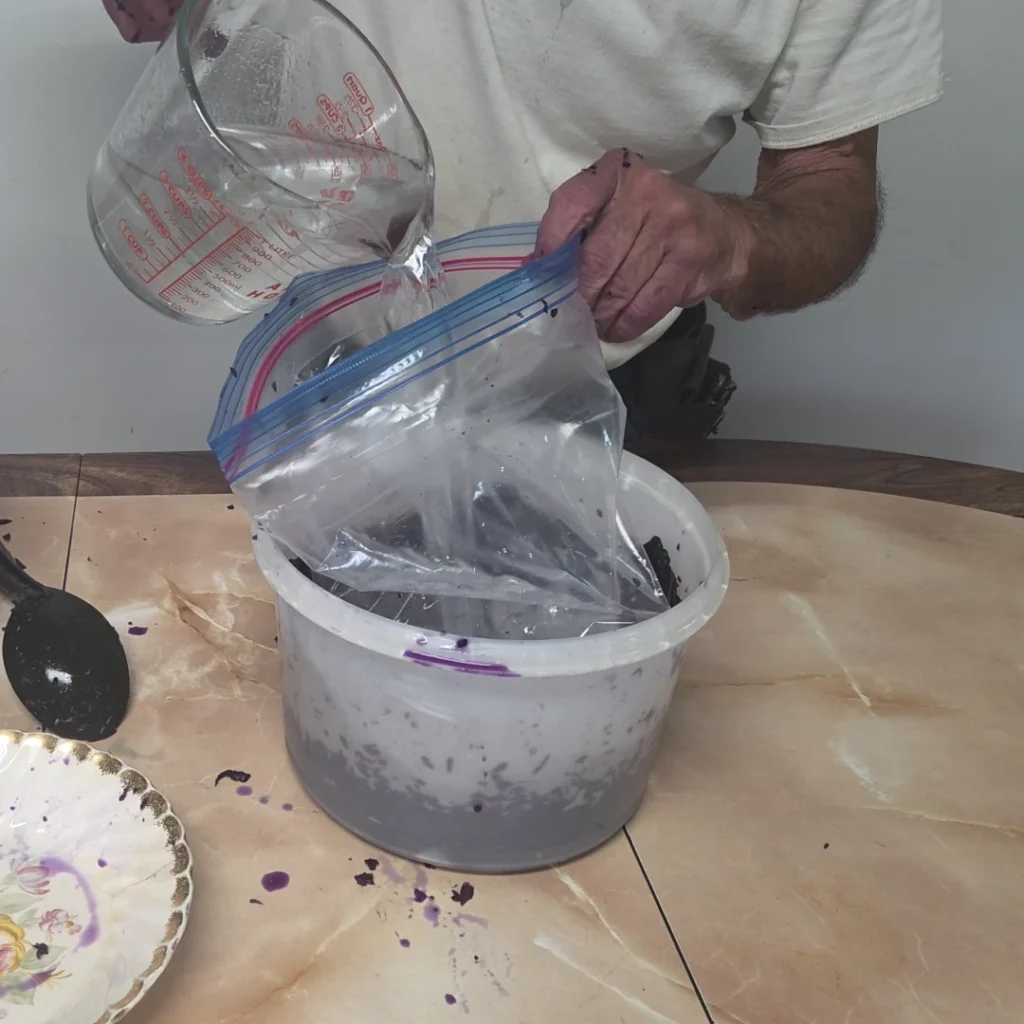
About four hours later, I checked on it. By then, the brine had risen enough to cover the cabbage leaves and everything underneath them.
The next day, there was even more brine, and it was well above the top of the cabbage. From then on, I checked on the sauerkraut every day to make sure everything was staying submerged.
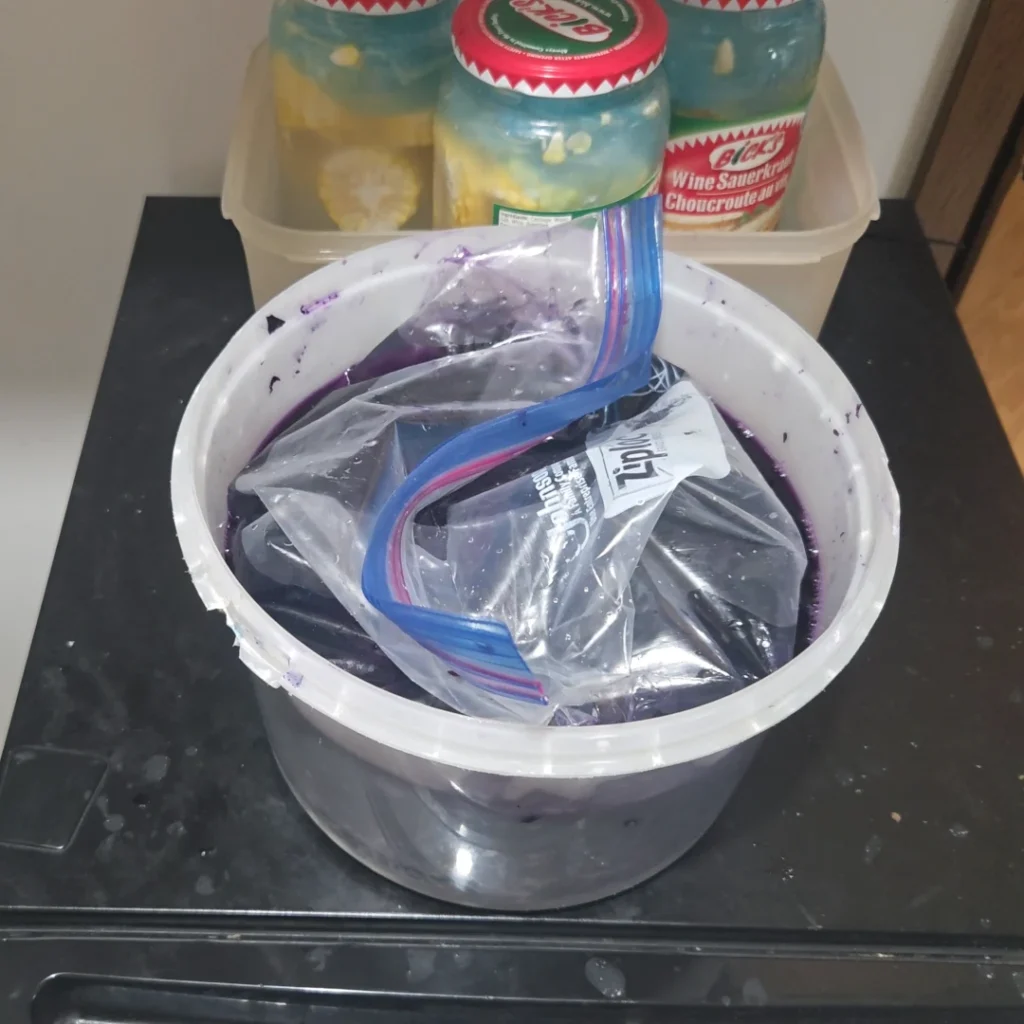
On the 12th day, I noticed a small amount of white growth along the edge of one of the cabbage leaves. I simply removed that part of the leaf and continued with the fermentation.
By the 16th day, I decided it was time to stop the fermentation. I tasted the sauerkraut and it was starting to lose some of its crunch, so I decided that 16 days was long enough for this batch.
I packed the sauerkraut into pint jars, put the lids on, and moved them into the refrigerator.
You can also process sauerkraut in a boiling water bath if you want to store it on the shelf instead of keeping it refrigerated. The fermentation process creates probiotics, but the heat from water-bath canning kills those live probiotics. The heat also creates postbiotics from the probiotics that were produced during fermentation, so even though canned sauerkraut no longer contains the same live probiotics as refrigerated sauerkraut, you still get the benefits of the postbiotics.
Water-Bath Canning Sauerkraut
If you want to store your sauerkraut on the shelf instead of keeping it refrigerated, you can process it in a boiling water bath. There are two ways you can pack the jars: raw pack or hot pack.
Raw Pack
For the raw-pack method, pack the fermented sauerkraut into clean, hot pint jars, leaving ½ inch of headspace. Ladle the sauerkraut’s brine over the cabbage, making sure the sauerkraut is covered while still leaving the required headspace.
Remove any air bubbles by running a nonmetallic spatula or bubble remover around the inside of the jar. Wipe the jar rims clean, place the prepared lids on the jars, and screw on the bands until they are fingertip tight.
Place the jars into the boiling water bath, making sure the water covers the jars by at least 1 inch. Bring the water back to a full boil before starting the processing time.
Process pint jars for 10 minutes. If you are canning at an altitude above 1,000 feet, adjust the processing time according to the altitude recommendations for your location.
Hot Pack
For the hot-pack method, put the fermented sauerkraut and its brine into a large pot and slowly bring it to a simmer. Stir it occasionally while it heats. You don’t want to cook the sauerkraut for a long time; the idea is simply to heat it thoroughly before filling the jars.
Ladle the hot sauerkraut and brine into clean, hot pint jars, leaving ½ inch of headspace. Remove any air bubbles by running a nonmetallic spatula or bubble remover around the inside of the jar. Wipe the jar rims clean, place the prepared lids on the jars, and screw on the bands until they are fingertip tight.
Place the jars into the boiling water bath, making sure the water covers the jars by at least 1 inch. Bring the water back to a full boil before starting the processing time.
Process pint jars for 10 minutes. If you are canning at an altitude above 1,000 feet, adjust the processing time according to the altitude recommendations for your location.
When the processing time is finished, turn off the heat and carefully remove the jars from the canner. Place them upright on a towel and leave them undisturbed for 12 to 24 hours.
After the jars have cooled, check the seals. Any jar that hasn’t sealed should be refrigerated and used first. Remove the bands from sealed jars, wipe the jars clean, label them, and store them in a cool, dark place.
How Much Salt Should You Use?
When making sauerkraut, the amount of salt you use can be anywhere from 1.5% to 2.5% of the weight of the cabbage. I used 2.5% for this batch, and I found that it makes a pretty salty sauerkraut.
If this is your first time making sauerkraut, I would recommend starting with 2% salt. That gives you a good starting point without making the finished sauerkraut as salty as this batch. Once you have made a batch, you can adjust the amount of salt up or down to suit your own taste.
That’s all there is to making red sauerkraut. Get the salt ratio right, work the cabbage until you have plenty of juice, and most importantly, keep the cabbage under the brine while it ferments.

This batch turned out great. The red cabbage made a beautiful sauerkraut, and the 16-day fermentation gave it a good sour flavor while still leaving some crunch. It’s a pretty simple process, and once you get the cabbage packed down and covered with brine, most of the work is just letting time do its thing.
Red Sauerkraut
Fermentation Time: 16 days
Yield: 5 pints
Ingredients
- 1500 grams purple cabbage, including the outer leaves used to cover the sauerkraut
- 37.5 grams salt (2.5% of the cabbage weight)
- 2.5% salt-water brine, as needed for the fermentation weight
Instructions
- Rinse the cabbage and remove the core.
- Weigh the cabbage. For this batch, the cabbage weighed 1500 grams.
- Calculate the salt needed based on the weight of the cabbage. For 2.5% salt, 1500 grams of cabbage requires 37.5 grams of salt.
- Remove the outer cabbage leaves and set them aside. These leaves will be used later to cover the sliced cabbage and should be included in the total cabbage weight when calculating the amount of salt.
- Cut the cabbage into pieces small enough to fit into a food processor. Using the slicing blade, slice all of the cabbage.
- Place some of the sliced cabbage into a large bowl and sprinkle some of the salt over it. Add more cabbage and more salt until all of the cabbage and salt have been added.
- Mix the cabbage and salt together and let it sit for about 30 minutes. This gives the salt time to begin drawing moisture from the cabbage.
- After 30 minutes, crush and squeeze the cabbage by hand for about 20 minutes to release as much juice as possible. If your hands get tired, take a break and then continue working the cabbage. The goal is to release enough juice to completely cover the cabbage.
- Place the cabbage and all of the juice into a clean one-gallon container.
- Lay the reserved outer cabbage leaves over the sliced cabbage and press everything down firmly. Place a freezer bag over the cabbage and fill the bag with 2.5% salt-water brine. The bag acts as a weight to keep the cabbage submerged, even if the brine already covers the cabbage. Cover the container with a clean towel to keep out bugs and dirt.
- Check the sauerkraut after several hours. As the cabbage releases more juice, the brine should rise and completely cover the cabbage and the leaves.
- Check the sauerkraut every day during fermentation and make sure the cabbage remains completely submerged under the brine.
- Ferment for approximately 16 days, or until the sauerkraut reaches the desired flavor and texture. For this batch, a small amount of white growth appeared on the edge of one of the cabbage leaves on day 12. That portion of the leaf was removed and fermentation continued.
- On day 16, taste the sauerkraut. When the desired level of sourness is reached and before the cabbage loses too much crunch, stop the fermentation.
- Pack the finished sauerkraut into 5 clean pint jars, cover with lids, and refrigerate.
Salt Amount
Salt for sauerkraut can range from 1.5% to 2.5% of the weight of the cabbage. This recipe uses 2.5% salt, which produces a fairly salty sauerkraut. For your first batch, 2% salt is a good place to start, and you can adjust the amount in future batches to suit your taste.
Optional Water-Bath Canning
If you want to store the finished sauerkraut at room temperature instead of refrigerating it, you can process it in a boiling water bath. You can use either the raw-pack or hot-pack method.
Raw Pack
- Pack the fermented sauerkraut into 5 clean, hot pint jars, leaving ½ inch headspace.
- Ladle the sauerkraut brine over the cabbage, keeping the sauerkraut covered while maintaining ½ inch headspace.
- Remove air bubbles with a nonmetallic spatula or bubble remover.
- Wipe the jar rims clean. Place the prepared lids on the jars and screw on the bands until fingertip tight.
- Place the jars into a boiling water bath. Make sure the water covers the jars by at least 1 inch.
- Bring the water back to a full boil and process pint jars for 10 minutes. Adjust processing time for altitude according to current canning guidelines.
- When processing is complete, remove the jars and place them upright on a towel. Leave them undisturbed for 12 to 24 hours.
- Check the seals. Refrigerate and use any jar that has not sealed. Remove the bands from sealed jars, wipe the jars clean, label, and store in a cool, dark place.
Hot Pack
- Place the fermented sauerkraut and its brine into a large pot.
- Slowly heat the sauerkraut and brine to a simmer, stirring occasionally. Heat thoroughly without cooking the sauerkraut for an extended period.
- Ladle the hot sauerkraut and brine into 5 clean, hot pint jars, leaving ½ inch headspace.
- Remove air bubbles with a nonmetallic spatula or bubble remover.
- Wipe the jar rims clean. Place the prepared lids on the jars and screw on the bands until fingertip tight.
- Place the jars into a boiling water bath. Make sure the water covers the jars by at least 1 inch.
- Bring the water back to a full boil and process pint jars for 10 minutes. Adjust processing time for altitude according to current canning guidelines.
- When processing is complete, remove the jars and place them upright on a towel. Leave them undisturbed for 12 to 24 hours.
- Check the seals. Refrigerate and use any jar that has not sealed. Remove the bands from sealed jars, wipe the jars clean, label, and store in a cool, dark place.
Note: Fermentation creates probiotics. The heat from water-bath canning kills the live probiotics, but the heat also creates postbiotics from the probiotics produced during fermentation.
Print RecipeFrequently Asked Questions
How much salt do I need to make sauerkraut?
The amount of salt can range from 1.5% to 2.5% of the total weight of the cabbage. I used 2.5% for this batch, which made a fairly salty sauerkraut. If this is your first batch, I recommend starting with 2% salt and adjusting it to your taste in future batches.
How do I calculate the amount of salt for sauerkraut?
Weigh your cabbage and multiply the weight by the percentage of salt you want to use. For example, 1500 grams of cabbage multiplied by 0.025 for 2.5% salt equals 37.5 grams of salt.
Should I include the outer cabbage leaves when calculating the salt?
Yes. If you plan to use the outer leaves to cover the sauerkraut and they will be under the brine during fermentation, include them in the total weight when calculating the amount of salt.
How long does red sauerkraut take to ferment?
The fermentation time depends on temperature and how sour and crunchy you like your sauerkraut. I fermented this batch for 16 days. On day 16, I tasted it and decided it was starting to lose some of its crunch, so I stopped the fermentation.
Why do I need to keep the cabbage under the brine?
Keeping the cabbage submerged under the brine helps protect it during fermentation. The cabbage should remain covered by the brine throughout the fermentation process.
What can I use to keep sauerkraut submerged?
A freezer bag filled with 2.5% salt-water brine works well as a weight. Place the bag over the cabbage and fill it with enough brine to press the cabbage down and keep it submerged. Using salt water in the bag also means that if the bag leaks, it won’t dilute the sauerkraut brine.
Why do I cover the sauerkraut with a towel?
The towel helps keep bugs and dirt out of the fermentation container while still allowing the sauerkraut to ferment.
What if my cabbage doesn’t release enough juice?
Spend more time crushing and squeezing the cabbage by hand to release the juice. If your hands get tired, take a break and then work the cabbage some more. The goal is to release enough juice to cover the cabbage completely.
What if I see something growing on the cabbage leaves?
Check the sauerkraut regularly during fermentation. In this batch, I noticed a small amount of white growth on the edge of one of the outer cabbage leaves on day 12. I removed that part of the leaf and continued the fermentation.
Can I store sauerkraut in the refrigerator?
Yes. Once the sauerkraut has reached the flavor and texture you want, pack it into clean jars, cover with lids, and refrigerate.
Can I water-bath can sauerkraut?
Yes. Fermented sauerkraut can be processed in a boiling water bath for shelf storage. You can use either a raw-pack or hot-pack method. The processing instructions should be followed carefully, including the correct headspace and processing time for your altitude.
What is the difference between raw pack and hot pack sauerkraut?
With the raw-pack method, the fermented sauerkraut is packed directly into jars and covered with its brine before processing. With the hot-pack method, the sauerkraut and brine are heated before being packed into the jars and processed.
Does canning sauerkraut kill the probiotics?
The fermentation process creates probiotics, but the heat from water-bath canning kills those live probiotics. The heat also creates postbiotics from the probiotics produced during fermentation.

Leave a Reply